The Backyard Observatory
- Identify converging lenses by their effect
- Explain how two lenses magnify
- Construct a working telescope tube
- Predict and set the focus and test it
- Transfer to real telescopes and cameras
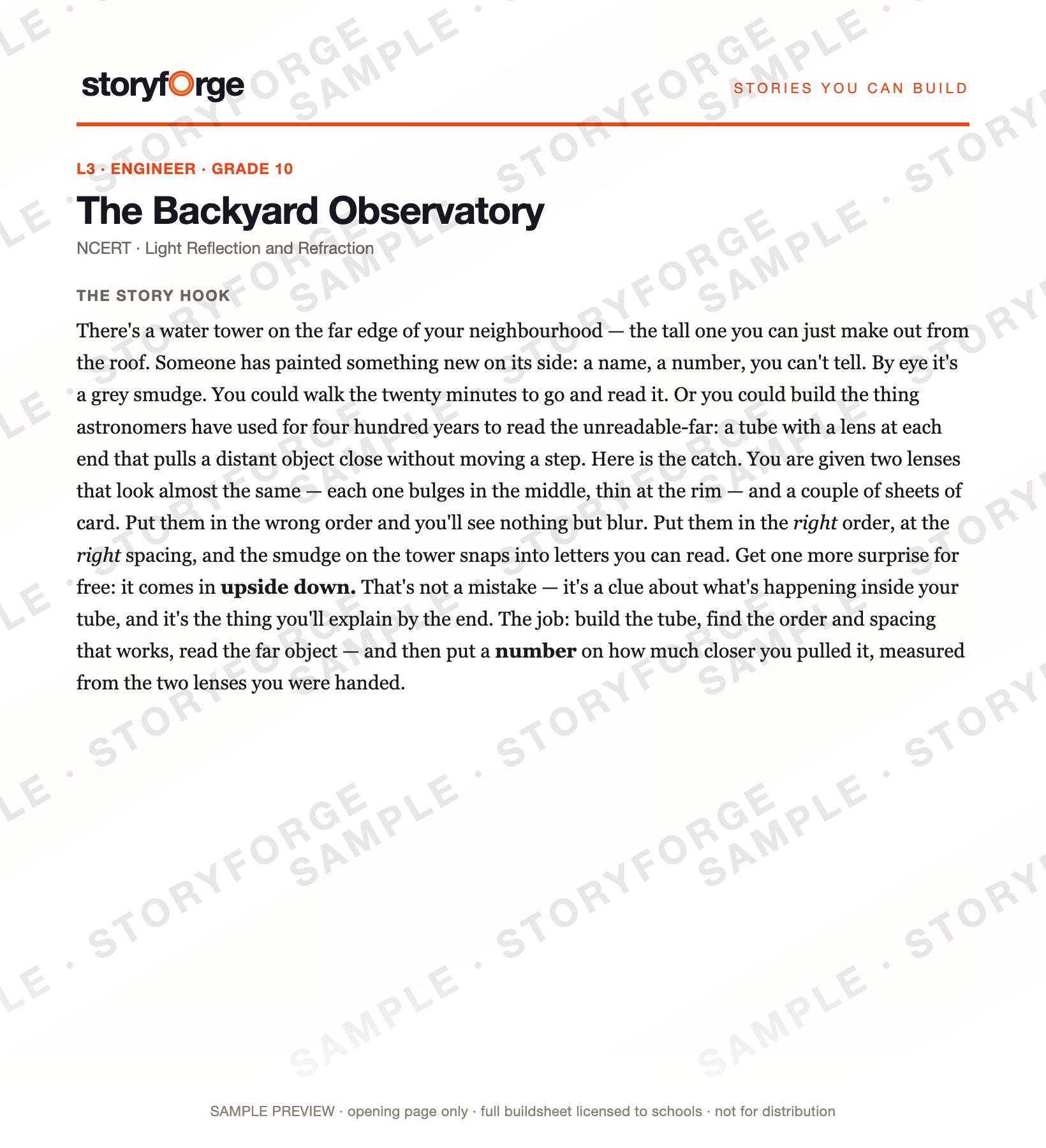
There's a water tower on the far edge of your neighbourhood — the tall one you can just make out from the roof. Someone has painted something new on its side: a name, a number, you can't tell. By eye it's a grey smudge. You could walk the twenty minutes to go and read it. Or you could build the thing astronomers have used for four hundred years to read the unreadable-far: a tube with a lens at each end that pulls a distant object close without moving a step.
Here is the catch. You are given two lenses that look almost the same — each one bulges in the middle, thin at the rim — and a couple of sheets of card. Put them in the wrong order and you'll see nothing but blur. Put them in the right order, at the right spacing, and the smudge on the tower snaps into letters you can read. Get one more surprise for free: it comes in upside down. That's not a mistake — it's a clue about what's happening inside your tube, and it's the thing you'll explain by the end.
The job: build the tube, find the order and spacing that works, read the far object — and then put a number on how much closer you pulled it, measured from the two lenses you were handed.
| Option | Price | +GST |
|---|---|---|
| PDF licence (content, per module) | ₹8,000 | ₹9,440 |
| PDF + kits (one class · 8 team kits) | ₹8,459.20 | ₹9,981.86 |
| Grade 10 bundle (all 4 modules) | ₹25,600 | ₹30,208 |
Per-team kit works out to about ₹41. Prices from the module's live bill of materials; GST shown separately.
Enquire about The Backyard Observatory
We'll send the full sample module and a quote — PDF licence, PDF + kits, or the grade bundle.
Email us — hello@storyforge.co.in