The Cargo Run
- Identify action-reaction in the car's motion
- Explain how stored energy becomes motion
- Construct a self-powered payload car
- Predict how payload mass changes distance and test it
- Troubleshoot a car that veers or stalls
- Transfer to real propulsion
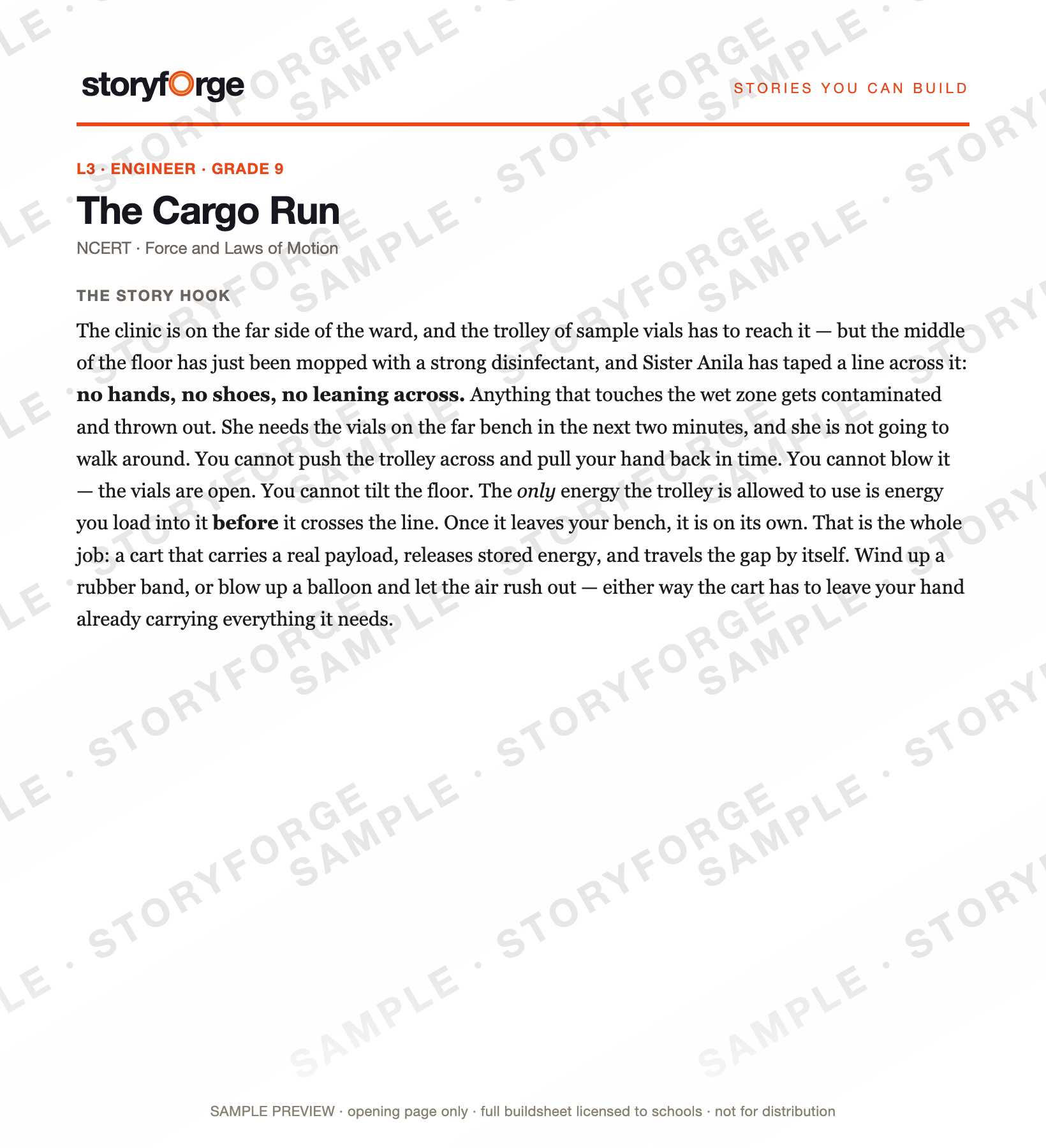
The clinic is on the far side of the ward, and the trolley of sample vials has to reach it — but the middle of the floor has just been mopped with a strong disinfectant, and Sister Anila has taped a line across it: no hands, no shoes, no leaning across. Anything that touches the wet zone gets contaminated and thrown out. She needs the vials on the far bench in the next two minutes, and she is not going to walk around.
You cannot push the trolley across and pull your hand back in time. You cannot blow it — the vials are open. You cannot tilt the floor. The only energy the trolley is allowed to use is energy you load into it before it crosses the line. Once it leaves your bench, it is on its own.
That is the whole job: a cart that carries a real payload, releases stored energy, and travels the gap by itself. Wind up a rubber band, or blow up a balloon and let the air rush out — either way the cart has to leave your hand already carrying everything it needs.
| Option | Price | +GST |
|---|---|---|
| PDF licence (content, per module) | ₹8,000 | ₹9,440 |
| PDF + kits (one class · 8 team kits) | ₹8,302.40 | ₹9,796.83 |
| Grade 9 bundle (all 4 modules) | ₹25,600 | ₹30,208 |
Per-team kit works out to about ₹27. Prices from the module's live bill of materials; GST shown separately.
Enquire about The Cargo Run
We'll send the full sample module and a quote — PDF licence, PDF + kits, or the grade bundle.
Email us — hello@storyforge.co.in