The Motor That Shouldn't Spin
- Identify the parts that make a motor turn
- Explain how current in a field makes a force
- Construct a spinning DC motor from bare parts
- Predict the effect of reversing current and test it
- Troubleshoot a motor that will not start
- Transfer to real electric motors
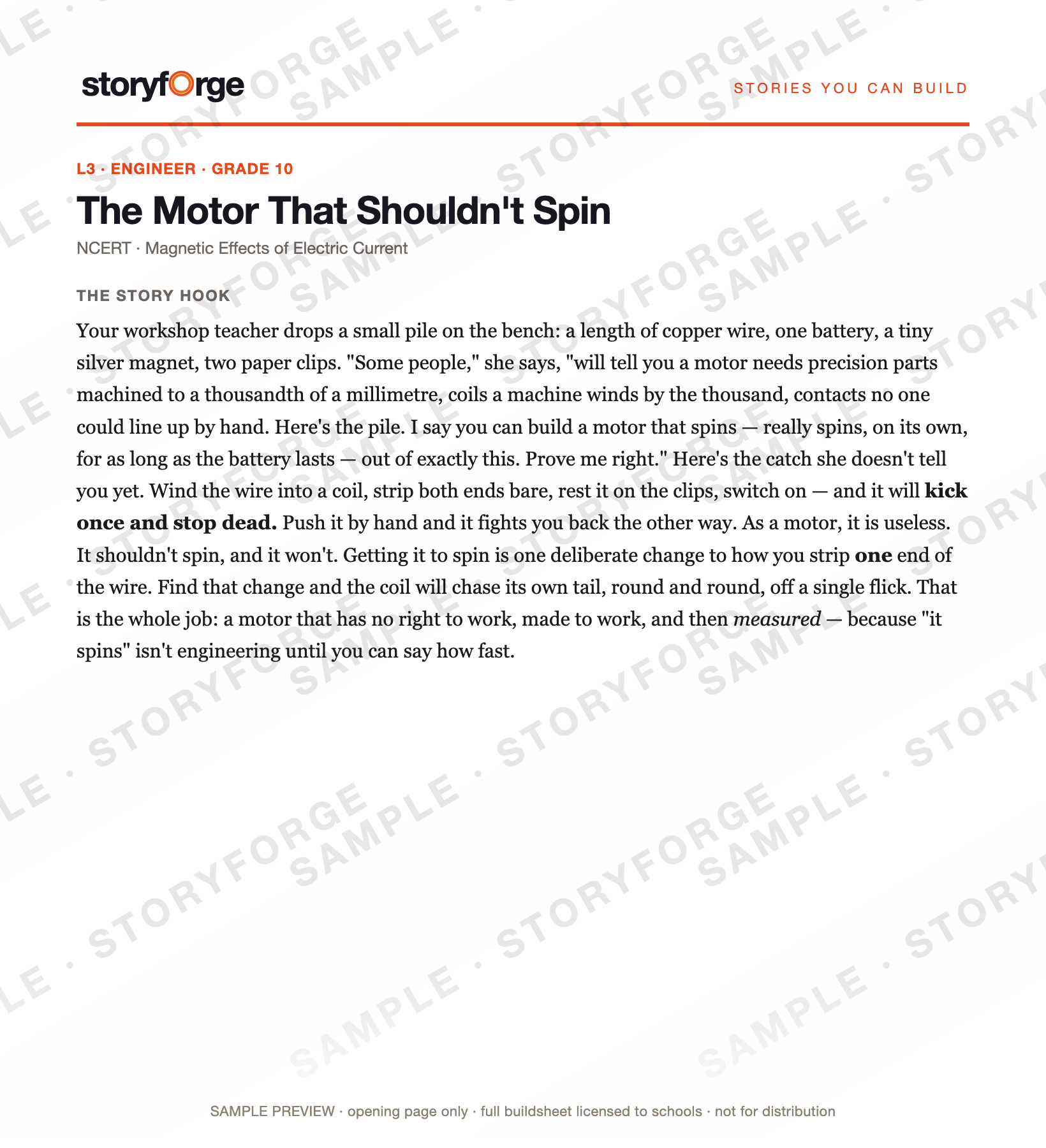
Your workshop teacher drops a small pile on the bench: a length of copper wire, one battery, a tiny silver magnet, two paper clips. "Some people," she says, "will tell you a motor needs precision parts machined to a thousandth of a millimetre, coils a machine winds by the thousand, contacts no one could line up by hand. Here's the pile. I say you can build a motor that spins — really spins, on its own, for as long as the battery lasts — out of exactly this. Prove me right."
Here's the catch she doesn't tell you yet. Wind the wire into a coil, strip both ends bare, rest it on the clips, switch on — and it will kick once and stop dead. Push it by hand and it fights you back the other way. As a motor, it is useless. It shouldn't spin, and it won't.
Getting it to spin is one deliberate change to how you strip one end of the wire. Find that change and the coil will chase its own tail, round and round, off a single flick. That is the whole job: a motor that has no right to work, made to work, and then measured — because "it spins" isn't engineering until you can say how fast.
| Option | Price | +GST |
|---|---|---|
| PDF licence (content, per module) | ₹8,000 | ₹9,440 |
| PDF + kits (one class · 8 team kits) | ₹8,862.40 | ₹10,457.63 |
| Grade 10 bundle (all 4 modules) | ₹25,600 | ₹30,208 |
Per-team kit works out to about ₹77. Prices from the module's live bill of materials; GST shown separately.
Enquire about The Motor That Shouldn't Spin
We'll send the full sample module and a quote — PDF licence, PDF + kits, or the grade bundle.
Email us — hello@storyforge.co.in